
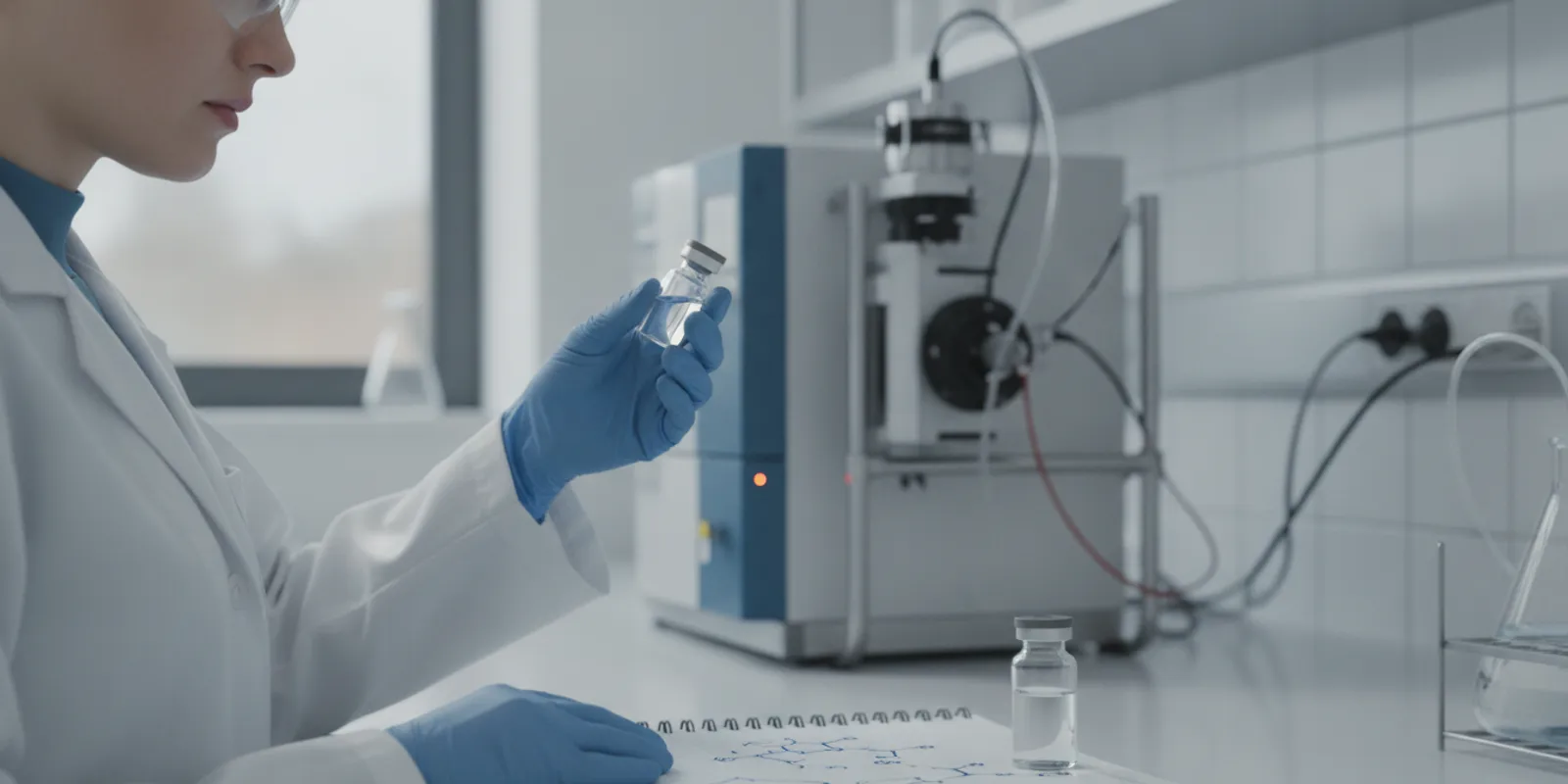
The phrase peptide versus small molecule research compound can sound like a simple comparison of two labels. For a laboratory team, it is better treated as a planning question: what is the material’s documented identity, what properties matter to the assay, and what evidence will make results interpretable? A peptide is not automatically the right choice because it is a peptide, and a small molecule is not automatically easier to study. The research question, model, available methods, and records should drive the comparison.
Contact Core Pepti about research materials
What question should the comparison answer?
Start by stating the scientific question without assuming a material class. Are you comparing a defined sequence with a reference, examining a compound’s behavior in a specific in-vitro model, or checking whether an analytical method can distinguish related materials? Each question leads to different requirements. A study intended to assess assay compatibility may need different documentation from one focused on identity confirmation or method development.
Write down the planned comparison before selecting a material. Include the model, conditions, controls, endpoints, and the result that would count as informative. Avoid choosing a compound based on a broad label alone. A product name, a category page, or a seller description is not a substitute for a research protocol that defines what is being tested.
- Define the question: Identify the property or response the experiment is designed to examine.
- Set the boundaries: Specify the in-vitro model and the scope of the planned work.
- List the evidence needed: Decide what identity, characterization, and sample records the team must review.
- Choose the comparison: Select materials that can answer the same defined question under comparable conditions.
How do peptides and small molecules differ as material classes?
Peptides are chains of amino-acid residues. Small molecules are a broad category of lower-molecular-size compounds with varied structures and chemistries. These labels describe chemical class, not a complete prediction of how a particular material will behave in a particular assay. Sequence, modifications, structure, formulation, purity profile, solvent conditions, and the experimental system can all matter.
The distinction is useful when setting up procurement and documentation, but it should not become a shortcut for assumptions. Do not infer solubility, stability, activity, compatibility, or analytical suitability from “peptide” or “small molecule” alone. Those properties need to be established for the specific material and the intended laboratory conditions. A research team should consult suitable technical documentation and develop its own method plan rather than extrapolating from the category name.
There is also an important distinction between a compound’s chemistry and the way it is presented for sale. A capsule is a product format; it does not define whether its contents are a peptide or a small molecule. Core Pepti’s catalog includes capsule-format listings, and Tesofensine is described in the company’s information as a small molecule. Record chemical identity and supplied format as separate fields. Do not treat capsule format as evidence that a material is a supplement or intended for use outside qualified in-vitro research.
That separation prevents a common data problem. If one spreadsheet column says “capsule” and another says “peptide,” the entries are not necessarily competing classifications: one describes presentation, the other chemistry. A material can be recorded as a small molecule supplied in capsule format, or as a peptide supplied in a different presentation. The right record keeps both facts visible without using format to infer composition, purpose, or suitability.
Which identity details should be recorded?
Before comparing materials, establish what each sample is supposed to be. A name alone may not resolve ambiguity, especially where abbreviations, blend names, or similar labels appear. Record the exact identity information available and flag anything that remains unconfirmed.
- Material name and identifier: Preserve the supplier’s exact listing name and any catalog identifier provided.
- Chemical identity: For a peptide, document the sequence and any stated modifications when available. For a small molecule, capture an unambiguous chemical identifier and structure reference where available.
- Strength and unit: Record the stated amount and unit exactly. Do not infer strength from a URL, category, or abbreviated product title.
- Composition: For a blend, list each component and its stated amount separately. Avoid converting component amounts into an unsupported combined amount.
- Format: Record whether the supplied item is a powder, solution, capsule, or other presentation independently of chemical class.
- Lot and receipt details: Preserve lot or batch identifier when provided, receipt date, packaging condition, and accompanying records.
If an identity or amount is unclear, pause the comparison and seek clarification rather than silently normalizing the record. This is especially important when a catalog title, page label, and product description do not align. A discrepancy should be treated as a documentation issue to resolve, not as permission to select the most convenient interpretation.
A useful record is precise enough that a second researcher can tell what was received without having to reconstruct it from memory. For example, “capsule sample, 60 count” is a format description, not a chemical identity. “Peptide blend” may identify a broad class but does not provide the component list. Preserve the source wording, then add clearly labeled fields for verified details and unresolved questions. Do not overwrite the original entry when a discrepancy is corrected; keep the correction and its basis traceable.
How should molecular properties inform planning?
Consider the properties that are relevant to the experimental question, then distinguish known facts from assumptions. Depending on the study, a team may need to consider molecular mass, charge, sequence or structure, hydrophobicity, potential aggregation, solubility, or sensitivity to environmental conditions. Not every property matters equally for every assay, and a property label does not guarantee performance in a particular buffer or model.
Translate each relevant property into a planning question. If solubility is important, determine what evidence or method will establish whether the material can be handled under the planned conditions. If aggregation or adsorption could affect measurement, include appropriate checks and controls. If a modification changes the expected analytical signal, make sure the method can account for it. These are method-development questions, not grounds for making claims about outcomes beyond the experiment.
| Planning dimension | Peptide material | Small-molecule material | Record or check |
|---|---|---|---|
| Identity | Sequence, modifications, and stated composition where available | Structure or unambiguous chemical identifier where available | Preserve exact name, identifiers, and unresolved discrepancies |
| Assay fit | Assess whether the defined sequence and material form suit the assay question | Assess whether the specific structure and material form suit the assay question | State model, conditions, controls, and measurable endpoints |
| Analytical approach | Choose methods capable of addressing relevant identity and characterization questions | Choose methods capable of addressing relevant identity and characterization questions | Document method scope, reference materials, and limitations |
| Format | May be supplied in different presentations; format is not chemical identity | May also be supplied in different presentations; format is not chemical identity | Record format and chemical class as separate fields |
| Sample history | Track lot, receipt, storage conditions, and preparation records | Track lot, receipt, storage conditions, and preparation records | Use a consistent chain of sample records and note deviations |
A property checklist works best when it is tied to a decision. “Solubility” by itself is only a heading. A useful note says why solubility matters to the assay, what observation or documentation can answer the question, and what the team will do if the evidence is inconclusive. This keeps a list of chemical descriptors from becoming a substitute for method planning.
Teams should also separate a property that is stated in documentation from one they have measured under their own conditions. A supplier description may offer a starting point for review, but the laboratory’s buffer, vessel, temperature, concentration range, and measurement system may differ. Mark the source of each claim and avoid presenting a literature or catalog description as a result from the current study.
Which analytical methods belong in the comparison?
Method selection should follow the question the team needs to answer. No single method establishes every aspect of identity, composition, purity, stability, and suitability. A method can be useful within a defined scope while leaving other questions unanswered. Record what the method measures, what reference or control is used, and what limitation remains.
For peptide and small-molecule materials alike, analytical planning may involve orthogonal methods: approaches that examine different properties and can provide complementary evidence. Depending on the material and objective, teams may consider chromatographic separation, mass-based characterization, spectroscopic measurements, or other validated laboratory methods. The specific method must be chosen and interpreted by qualified personnel in the context of the study; this overview does not prescribe a protocol.
When reviewing supplier-provided quality language, separate a general statement from evidence tied to the sample in hand. Core Pepti states that it emphasizes analytical characterization and batch consistency. Those statements should not be rewritten as proof that a particular lot has been independently verified. For a specific study, determine what lot-matched documentation is available, who generated it, what method and acceptance criteria are described, and whether it addresses the question your assay requires.
Useful questions for a method review include:
- Does the document identify the exact material, format, and lot being evaluated?
- Is the method named, and is its intended measurement clear?
- Are results and reference standards described sufficiently for the laboratory’s purpose?
- Does the evidence address identity, amount, or another defined property rather than implying all of them?
- Are limitations, unresolved peaks, or deviations reported?
Consider two different reasons for requesting analytical information. In an identity-focused review, the central question is whether the evidence supports the stated material identity and distinguishes it from plausible alternatives. In a method-development exercise, the priority may be whether the analytical platform gives a useful and repeatable signal under the laboratory’s conditions. These goals overlap, but they are not interchangeable. A document that supports one does not automatically answer the other.
Likewise, a reported measurement needs context. The sample identifier, method, date, reference material, and interpretation criteria help establish what a result means. If a document gives a single number without explaining the measurement or sample linkage, record that limitation instead of assigning it a broader meaning. Ask focused questions: which sample was examined, what property was assessed, and what does the method leave unresolved?
Orthogonal evidence can be useful because methods may respond to different features. But “more methods” is not automatically better if the methods do not map to the study question or if the records are not connected to the same material. Build a small evidence matrix with columns for the question, evidence source, method scope, sample or lot match, and remaining limitation. The matrix makes it easier to see whether the team has a genuine gap or merely a set of documents that answer different questions.
How should handling records support reproducibility?
A reproducible comparison depends on the sample trail as well as the assay. Use a consistent record for each material, regardless of chemical class. Capture receipt, labeling, lot identifiers, packaging observations, storage instructions supplied with the material, preparation records, and any transfer or freeze-thaw history relevant to the laboratory’s established procedures. Follow applicable institutional safety and handling requirements.
Do not invent storage conditions when documentation is missing. Record the gap and obtain appropriate guidance before use in a study. Keep the original label or a faithful record of it, and link each prepared sample to its source material. If the team creates aliquots or working stocks under approved procedures, document the preparation and identify the resulting containers so the experimental record can be traced back to the original lot.
For capsule-format items, record that format accurately and do not assume the capsule shell, contents, or stated quantity resolves chemical identity. For blends, track each named component and its stated amount as supplied. These distinctions help prevent a format label or shorthand from obscuring what the experiment actually evaluated.
One practical approach is to use a sample log with a stable identifier that does not change when a container is moved. The log can connect the received package to each prepared sample, instrument run, and data file. Record who made an entry and when, and make corrections in a way that preserves the earlier record. These simple conventions are especially helpful when multiple researchers handle the material or when a comparison continues over more than one work session.
Storage and preparation notes should reflect actual instructions and the laboratory’s established procedures, not assumptions based on chemical class. “It is a peptide, so it must be handled this way” is not a substitute for material-specific information. If details are absent, identify the uncertainty and determine whether it affects the planned work. If a departure from the documented plan occurs, record the event, its timing, and the samples affected. Do not quietly treat a deviation as if the original conditions were followed.
Sample history also matters when interpreting an unexpected result. If one candidate has a different receipt date, preparation path, or handling history, those differences may complicate a direct comparison. That does not prove they caused an observation, but it gives the team a concrete point to investigate. A well-kept log makes it possible to distinguish a material question from a process question.
How can a team choose an assay-relevant comparison?
Compare candidate materials against the planned assay requirements, not against broad claims about a chemical class. A practical review can use a short decision matrix:
- Match the question. Exclude any material that cannot address the defined research question.
- Check identity. Confirm that the stated name, composition, strength, and format are sufficiently clear for the planned work.
- Review analytical evidence. Identify the available characterization and the questions it does and does not answer.
- Assess method compatibility. Consider whether the assay can measure the relevant property and distinguish the intended comparison.
- Plan controls. Include controls and reference materials appropriate to the method and model.
- Review records and constraints. Ensure the team can document receipt, handling, preparation, and deviations within the laboratory’s research-only procedures.
Suppose a team is deciding between a peptide and a small molecule for a method-development exercise. The useful first question is not which class is “better.” It is whether the candidate’s identity is documented, whether the analytical platform can evaluate the needed feature, and whether the model and controls can support an interpretable result. If the candidates differ in several ways at once, a direct comparison may not isolate the factor of interest. The design may need additional controls or a narrower question.
A worked planning example helps make that issue concrete. Imagine a team wants to compare how two reference materials appear in an analytical workflow. One candidate is a peptide with a stated sequence and one modification; the other is a small molecule with a structural identifier. The goal is not to decide which class is superior. It is to determine whether the workflow can distinguish each candidate from relevant controls and whether the output is sufficiently documented for the next stage of method evaluation.
The team first writes down the intended measurement and the criteria for an interpretable run. It then records each candidate’s identity, format, lot, available characterization, and any missing details. If the peptide’s modification is not specified clearly, that becomes a question to resolve before treating it as a defined reference. If the small molecule’s identifier is unclear, the same rule applies. Neither candidate gets a pass merely because one label seems more familiar.
Next, the team maps potential confounders. The candidates may differ in structure, format, solubility behavior, and sample history. If the assay is intended to compare a method’s response to each material, those differences may be part of the question. If the goal is instead to isolate one analytical variable, the comparison may be too broad as initially framed. The team can narrow the question, add suitable reference or negative controls, or treat the materials as separate method-development cases rather than a head-to-head test.
Finally, the team records what the run can and cannot support. A successful measurement may show that the method generated a signal under specified conditions; it does not by itself establish every aspect of material identity, general suitability, or performance in another model. The written conclusion should stay at the level of the evidence and state what follow-up question remains. This bounded interpretation is more useful than a sweeping statement about peptides or small molecules as classes.
Teams can also use a sequence-design planning guide when sequence requirements are central, or review peptide synthesis method categories for background on how peptide materials may be produced. For broader study planning, the in-vitro research workflow resource can help structure the question, controls, and records.
What documentation should be reviewed before work begins?
Set a minimum documentation threshold before ordering or starting the study. The threshold should reflect the risk of ambiguity in the experiment and the standards of the laboratory. It can include:
- An exact material name, identifier, stated chemical identity, and format.
- Strength or component amounts expressed with units and without inferred totals.
- Lot or batch identification and receipt records.
- Available characterization documents linked to the relevant lot, with method scope and limitations understood.
- Storage or handling information appropriate to the supplied material and institutional procedures.
- A prewritten assay plan that states controls, endpoints, and how deviations will be recorded.
If a supplier’s page makes a broad claim but the records needed for the study are not available, keep the distinction visible in the project file. A missing document is not proof that a material is unsuitable, but it may mean the team cannot support a particular conclusion. Ask specific questions about the evidence rather than relying on a general assurance.
Core Pepti describes its materials as intended for research applications and its website limits them to qualified in-vitro work. Its published terms set the research-use boundary. Keep procurement, study design, and communication within that boundary; do not frame research materials as products for human or animal use. Purchasers must be 18 or older, and the materials are not foods, drugs, supplements, or cosmetics, nor are they evaluated or approved by the FDA.
Before work begins, a short review meeting can expose gaps that a document checklist misses. Ask the researcher responsible for the model, the person responsible for analytical interpretation, and the person maintaining sample records to review the same plan. Each should be able to identify the comparison, the material identifiers, the controls, and the limits of the intended conclusion. If those answers differ, resolve the disagreement before the experiment rather than after an ambiguous result.
What common comparison errors weaken interpretation?
- Treating class as a performance guarantee: Neither “peptide” nor “small molecule” answers whether a material will suit a specific assay.
- Mixing identity with format: A capsule or vial describes presentation, not chemical class or intended application.
- Using names as full specifications: Abbreviations and blends can conceal ambiguity. Preserve exact composition and ask for clarification where needed.
- Assuming a document proves everything: Analytical evidence should be interpreted within its stated method and scope.
- Comparing unlike candidates: If identity, format, strength, or conditions differ, a result may not isolate the variable the study intends to test.
- Leaving out sample history: Incomplete receipt and preparation records make it harder to connect an observation to a specific material.
- Making outcome claims from research plans: An in-vitro comparison does not justify claims about clinical, therapeutic, diagnostic, or consumer effects.
Another frequent error is deciding what the result means only after seeing it. If the team changes the interpretation criteria once data appear, it becomes harder to tell whether the conclusion reflects the planned question or a post hoc explanation. Record the main comparison, controls, and decision rules in advance. There can be legitimate reasons to revise a plan, but the change and its rationale should be recorded rather than hidden.
Teams can also overread a difference between two candidates when several variables changed at once. For instance, a different format, identity record, or preparation path may accompany a different chemical class. A result can still be useful, but it may answer a narrower question than intended. State which features were held constant, which differed, and which remain potential explanations. That discipline keeps a single observation from being turned into a broad class-level conclusion.
How should the final selection be documented?
Before work begins, write a brief selection rationale that names the research question, the candidate identity and format, the evidence reviewed, the planned analytical checks, and the limitations the team accepts. Note why the selected material is fit for the defined in-vitro task, not why one chemical class is universally preferable. Keep the rationale with the protocol and sample records so another qualified researcher can understand the decision.
A useful final record can follow a consistent sequence: state the question; list candidate materials exactly as documented; describe relevant properties and the source of each fact; summarize available analytical evidence; identify missing information; explain the controls and comparison logic; and define what conclusions the work will not support. This need not become a long report. A concise, structured note is often easier to review than scattered comments in email, ordering records, and instrument files.
For a future researcher, the decision record should make it possible to answer practical questions without guessing. Which lot was used? What format arrived? Were the named components of a blend recorded separately? What was the original comparison? Which method and controls were selected? What changed during the work? The more directly the record answers those questions, the easier it is to assess whether a later study is comparable.
Ask Core Pepti about research-material documentation
Peptides and small molecules are different chemical classes, but sound laboratory planning follows the same principle for both: define the question, verify what the material is, choose methods that answer the question, and keep a traceable record of the work.