
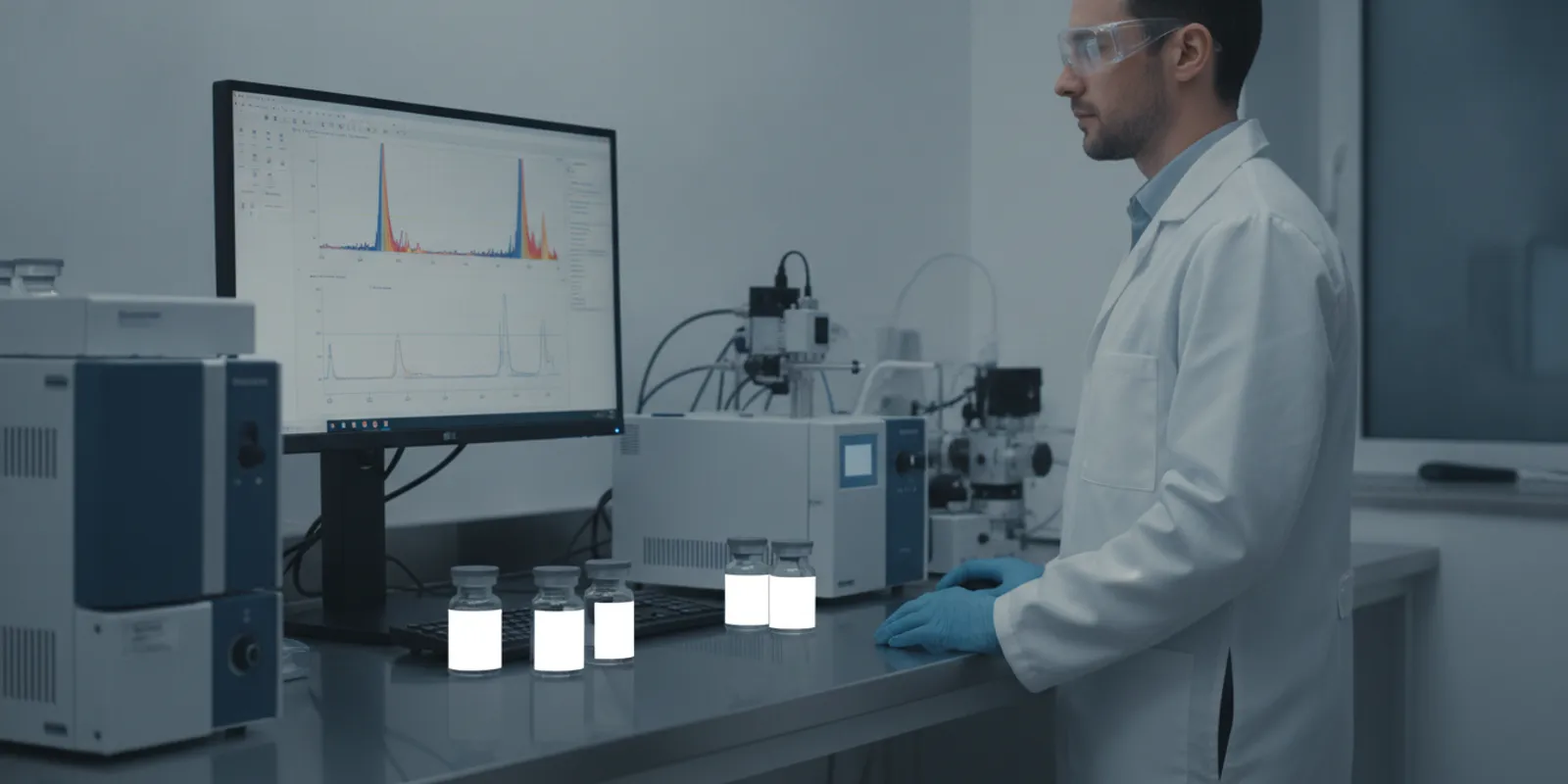
A peptide analytical testing workflow is more than a sequence of instruments. It is a documented plan that connects a research question to a sample, an appropriate analytical method, reviewable data, and a conclusion that stays within the evidence. This guide outlines a practical framework for qualified laboratory teams working with research-use-only materials in controlled in-vitro settings.
What question should the workflow answer?
Start by defining the decision the analysis is meant to support. A workflow can ask whether a received sample is consistent with its stated identity, whether a measured feature is present, whether a preparation behaves consistently across runs, or whether a method is suitable for a defined research purpose. These are different questions. They may require different methods, controls, acceptance criteria, and levels of documentation.
Write the question in one sentence before selecting an instrument. For example: “Does the analytical profile from this sample match the expected profile under the specified method?” That wording is more useful than “Is this sample good?” because it identifies an observation to evaluate without turning a limited result into a broad quality conclusion.
Then define the scope. Record the sample identifier, material description as received, research context, method version, and the decision that will follow from the result. State whether the exercise is exploratory, comparative, or part of a previously established laboratory procedure. A screening run may help decide what to investigate next, but it does not automatically establish identity, composition, or suitability for every future use.
Keep the analysis tied to a controlled in-vitro research purpose. Core Pepti describes its materials as research-use-only and intended for qualified professional laboratory research. The workflow should preserve that boundary in its protocol, sample labels, records, and downstream interpretation.
How do identity, composition, and purity differ?
Analytical results are easier to interpret when the team separates three common concepts. Identity asks whether the observed evidence is consistent with a proposed material. Composition concerns what components or signals are present in the sample under the method used. Purity is a method-dependent estimate of the relative contribution of a signal or component, not a universal description of every property of the material.
One measurement rarely answers all three questions. A chromatographic profile can show separated signals under a defined method, but a peak pattern alone may not establish a chemical identity. A mass measurement can provide evidence about molecular mass, but it does not necessarily show the full composition of a mixture or the amount of every component. Results need to be interpreted together with the method, reference information, sample history, and appropriate controls.
Use precise language in notes and reports. “A peak was observed at the recorded retention time” describes an observation. “The result is consistent with the reference under this method” states a bounded comparison. By contrast, “the sample is pure” or “the material is verified” can imply more than the data support unless the team defines the meaning, method, criteria, and evidence behind those terms.
For a useful review of these distinctions and the evidence that can support them, see Core Pepti’s guide to reviewing peptide analytical evidence. The aim is not to find one impressive number. It is to determine what each result actually measures and what remains unexamined.
Which information should be fixed before analysis?
Before preparing or measuring a sample, collect the information needed to make the run interpretable later. A missing detail can make a technically successful run difficult to compare with another one. An organized intake record is therefore part of the analytical workflow, not clerical work to postpone until after the instrument run.
- Sample identity: assign a unique internal identifier and preserve the description supplied with the material. Record the lot or batch identifier when one is provided. Do not silently correct an ambiguous name or infer a strength from a product-page label.
- Receipt and condition: note the date received, package condition, container identifiers, and any visible discrepancy. Record observations without guessing at an explanation.
- Research question: specify the property or comparison being examined and the decision the result will inform.
- Method details: identify the procedure or method version, instrument configuration, relevant settings, reference materials, and any deviations from the planned run.
- Controls and comparison: state which blanks, system checks, reference materials, replicate measurements, or comparison samples are planned and what each is intended to assess.
- Review criteria: define in advance what makes data usable for the stated purpose, what triggers repeat review, and who is responsible for approving the interpretation.
Record facts separately from assumptions. If a lot-specific document is unavailable, mark it as unavailable rather than treating a general product description as a substitute. If a sample label, identifier, or accompanying record conflicts with another source, pause the interpretation and resolve the mismatch through the laboratory’s normal quality process.
These practices help prevent a common error: comparing two results as if they came from equivalent materials and conditions when their identities, preparations, or methods were not actually aligned. The sample record should make those differences visible.
How should a team choose an analytical method?
Choose a method by matching the question to the kind of evidence the method can produce. Consider the expected property, sample matrix, available reference information, instrument capability, known method limitations, and the consequence of an uncertain result. A method is not appropriate simply because it is familiar or produces a clean-looking output.
Chromatographic methods can separate detectable components under defined conditions and produce a profile useful for comparison. Mass spectrometric methods can provide mass-related evidence and may help investigate molecular identity or composition. Spectroscopic methods can contribute information about molecular features or concentration in contexts where the method is suitable. The best choice depends on the research question and validated or otherwise characterized performance in the laboratory’s own scope.
These categories are not interchangeable. A separation profile and a mass signal answer different questions. A method may be sensitive to one feature and comparatively insensitive to another. A result can also be affected by sample preparation, matrix, instrument condition, reference quality, and data processing. The team should write down why the chosen method is expected to address the question and identify what it cannot establish.
| Analytical approach | Evidence it may contribute | Review questions | Important limit |
|---|---|---|---|
| Chromatographic separation | Profiles of separated, detectable signals under specified conditions | Are the method, run conditions, system checks, and comparison basis recorded? | A profile alone does not establish every component’s identity or amount. |
| Mass spectrometric measurement | Mass-related evidence that may support a proposed identity or composition review | Is the measurement suitable for the question, and is the reference interpretation documented? | A mass-related result does not by itself describe all sample components or properties. |
| Spectroscopic measurement | Signal patterns associated with molecular features or concentration in a suitable method | Are sample matrix, calibration or comparison approach, and method limits addressed? | Signal interpretation depends on method design and possible interferences. |
| Orthogonal method combination | Different kinds of evidence considered together | Do the methods answer complementary questions, and are discrepancies investigated? | More methods do not guarantee a stronger conclusion if their limits are not understood. |
Do not assume that combining methods automatically resolves uncertainty. Two outputs can appear to agree while relying on the same incomplete reference or an incorrect sample assignment. Conversely, differing outputs may reflect distinct measurement principles rather than a simple instrument failure. Determine in advance how the team will investigate a conflict.
What role do controls and reference materials play?
Controls make it possible to evaluate whether a run behaved as expected for its intended purpose. A blank can help reveal background signals or carryover under the conditions used. System suitability checks can show whether the instrument and method met defined run criteria. A reference material can provide a comparison point, when it is suitable and its own identity and handling are adequately documented. Replicates can help reveal variability in repeated measurements.
Each control should have a stated job. “We always include a blank” is not enough to show what the blank is expected to reveal or what result would require action. Link each control to a question, such as whether background is present, whether the system is performing within a defined range, or whether repeated measurements are sufficiently consistent for the planned comparison.
Controls do not repair weaknesses in sample identification, reference quality, or method design. A reference with unclear provenance may provide a poor comparison. A passing system check does not prove the identity of the research material. A replicate can show repeatability under the specific conditions tested, but it does not establish that another lot or method will behave the same way.
Document acceptance criteria before reviewing the outcome where practicable. This reduces the temptation to invent a pass threshold after seeing the data. If the laboratory changes criteria, records should explain what changed, why it changed, and which results were assessed under each version.
How should sample preparation and run conditions be documented?
Sample preparation can influence what the instrument detects. The record should make it possible for another qualified reviewer to understand how the sample entered the measurement process and which conditions could affect interpretation. Follow the laboratory’s established, appropriate procedure; this article is a planning framework, not a substitute for a validated method or laboratory safety requirements.
Capture the relevant preparation sequence at a level that supports reproducibility. Depending on the method, that may include the sample identifier, preparation date, materials and solutions used, equipment identifiers, responsible operator, method version, and any observed changes or deviations. Record units clearly and use consistent names for samples, reference materials, and outputs.
Run conditions deserve similar care. Capture the instrument and configuration, sequence or run identifier, method file or version, acquisition settings relevant to interpretation, and any system checks. If a method is adjusted, document the reason and distinguish the modified run from data generated under the earlier setup.
Do not rely on memory or informal file names to connect raw data to a sample. Use a traceable identifier in the run sequence and the corresponding record. When an instrument exports files automatically, verify that the file naming and storage process preserve the link. A result detached from its sample and method context may be impossible to review confidently.
How can data review stay proportional to the evidence?
Review the raw or instrument-generated output alongside the processed result. Confirm that the sample identifier, method version, run date, and instrument record align. Check whether planned controls met their criteria and whether any deviations, unusual signals, integration changes, or reruns are documented. Keep the original data and preserve a clear history of changes made during processing.
Separate observations from interpretations. A reviewer might first record what appeared in the output, then describe how it compares with a defined reference, and finally state the limited conclusion supported for the project. This structure makes it easier for another person to see where measurement ends and interpretation begins.
Use qualified language. A comparison may be “consistent with” a reference under specified conditions, “not resolved by this method,” or “inconclusive because the control did not meet its criterion.” These phrases preserve uncertainty instead of hiding it. Do not expand a single run into a general claim about all samples, lots, methods, or future research conditions.
For a more detailed framework for examining output and avoiding overinterpretation, use the related guide to peptide research data interpretation. The central question is always whether the evidence matches the original scope, rather than whether the result sounds decisive.
What should a team do when results conflict or are incomplete?
First, describe the conflict precisely. Identify which observations differ, which records or criteria apply, and whether the issue concerns sample identity, a control, an instrument output, a method variation, or an interpretation. Avoid labeling an unexpected result as an error until the available evidence has been reviewed.
Next, check the chain of context: sample identifier, lot details, preparation record, run sequence, method version, control outcomes, processing history, and reference information. A discrepancy can arise from a documentation mismatch as well as a measurement issue. Reconcile the records before making a broader claim.
If the evidence remains unclear, state what is known, what is not known, and what additional review would answer the open question. Depending on the research plan, a team may consult its established procedure, examine retained data, repeat a measurement under documented conditions, or use a complementary method. The choice should follow the question and relevant laboratory oversight, not a desire to force agreement.
Do not discard a result merely because it is inconvenient. Preserve the original output, document any repeat or reprocessing, and explain why a result was excluded from a particular comparison. An audit-friendly record shows both the path to the final interpretation and the uncertainties that remain.
How can a workflow make supplier information useful?
Supplier information is one input to a laboratory’s own material review. Read product descriptions, order records, and any accompanying documents as distinct sources, and note which source supports each statement. A general product page should not be treated as a lot-specific analytical record. Where lot-matched information is supplied, verify that its identifiers correspond to the received material and that the document describes the relevant method and scope.
Ask practical questions before relying on a document: Is the sample or lot identifier clear? Is the document dated? Does it identify the measurement method and the property reported? Is the result linked to the material received? Does the document distinguish raw observations from conclusions? Are limitations or method conditions stated? These questions help a team assess relevance without assuming that the presence of a document answers every analytical question.
Core Pepti states that its sourcing and characterization practices support research-material quality. That statement should be distinguished from a laboratory’s own review of a particular lot. No general supplier statement substitutes for the records and criteria a research team needs for its own work. For a broader buyer-oriented review framework, see how to evaluate a research peptide supplier.
Core Pepti’s catalog is a separate acquisition path for research materials. A listing is not by itself proof of a specific analytical outcome or a replacement for a laboratory’s assessment. Review the exact identity, strength, format, and research-only information on a product page before making a selection. The Core Pepti shop provides the catalog pathway.
Which workflow errors most often weaken a conclusion?
Several avoidable habits can make analytical findings harder to reproduce or overstate what they mean:
- Starting with a vague question. Without a defined decision, teams may collect data that do not resolve the actual uncertainty.
- Treating one method as universal. Every method has a measurement scope. A result should not be extended to properties it does not measure.
- Using undocumented comparison criteria. Criteria set after the result is known can make a conclusion difficult to assess fairly.
- Confusing a signal with an identity. An observed peak or feature needs an appropriate comparison and context before it supports an identity statement.
- Breaking sample-to-file linkage. A result without a traceable sample identifier, run record, and method version is difficult to reproduce.
- Omitting deviations. A changed procedure or unusual event can affect comparison. Record it even when the result appears acceptable.
- Reporting a broad conclusion from a narrow run. State the conditions and scope that were actually examined.
- Replacing evidence with a marketing statement. Keep supplier claims, received records, and laboratory observations distinct.
A simple review habit helps: for each conclusion, ask which record supports it, whether the method addresses that exact question, and what the result does not establish. If those answers are not clear, narrow the wording or identify the evidence still needed.
What review sequence can a laboratory use?
A team can make the workflow easier to repeat by using the same review sequence for each project. The sequence does not replace a validated procedure. It provides a structure for planning, recordkeeping, and interpretation.
- Define the research question. State the decision and the specific property or comparison under review.
- Establish scope and criteria. Identify the material, research context, method limits, controls, and data review criteria before the run.
- Confirm sample records. Link the sample and available lot information to the planned analysis; flag missing or conflicting details.
- Select a suitable method. Explain why it can provide the evidence needed and identify what it cannot resolve.
- Plan controls and records. Assign a purpose to each control and make sure run identifiers connect to the sample and method version.
- Conduct and document the work. Follow the laboratory’s applicable procedures and capture deviations, outputs, and relevant conditions.
- Review data before conclusions. Check controls, raw and processed output, identifiers, and processing history.
- Write a bounded interpretation. Link each statement to evidence, note uncertainties, and define the scope of the conclusion.
- Preserve the record. Store the method version, sample linkage, output, review, and final summary so another qualified reviewer can follow the reasoning.
A concise report can use a few stable headings: question and scope, sample and records reviewed, method and controls, observations, interpretation, limitations, and follow-up. That format reduces the chance that a result will be separated from the conditions that gave it meaning.
How should the record remain useful after the initial review?
A good record is useful to someone who did not perform the original run. It should make the reasoning visible without requiring that person to reconstruct the project from emails, instrument folders, and memory. Use consistent identifiers, versioned methods, dated records, and clear links between source data and the summary.
When a later run is compared with an earlier one, identify what stayed the same and what changed. Differences in sample lot, method version, preparation, equipment, reference, or acceptance criteria can affect whether the results are directly comparable. State any limits on comparison rather than treating matching file labels as proof of equivalent conditions.
Keep conclusions revisable when new evidence arrives. If an additional document, repeat measurement, or method review changes the interpretation, retain the original record and add a dated explanation. A transparent update is more useful than silently replacing an earlier conclusion.
Frequently asked questions
Does one analytical method confirm every property of a peptide sample?
No. Each method provides evidence within its measurement scope. Teams should connect the method to a defined question and avoid treating one output as a complete assessment of identity, composition, and purity.
Is a chromatographic peak enough to establish identity?
Not by itself in every context. A peak is an observed signal under specified conditions. Identity interpretation needs a suitable comparison, method context, and supporting evidence for the question being asked.
What should a team do if a lot identifier is missing?
Record the missing information and avoid inferring a lot link from unrelated material. Follow the laboratory’s normal process to clarify the record, and make the limitation visible in any interpretation that depends on sample traceability.
Can a general product description replace a lot-specific record?
No. A general description can explain how a material is presented, but it does not establish what a particular received lot showed in an analytical run. Keep supplier descriptions separate from lot-linked documents and the laboratory’s own observations.
What makes a workflow reproducible?
A reproducible workflow links a clear question, traceable sample identifiers, a documented method version, defined controls, retained data, and a bounded interpretation. Another qualified reviewer should be able to follow what was done and why the conclusion fits the evidence.
A careful peptide analytical testing workflow does not promise certainty from a single result. It gives laboratory teams a repeatable way to connect research questions, methods, records, and conclusions while keeping each claim within the evidence collected.