
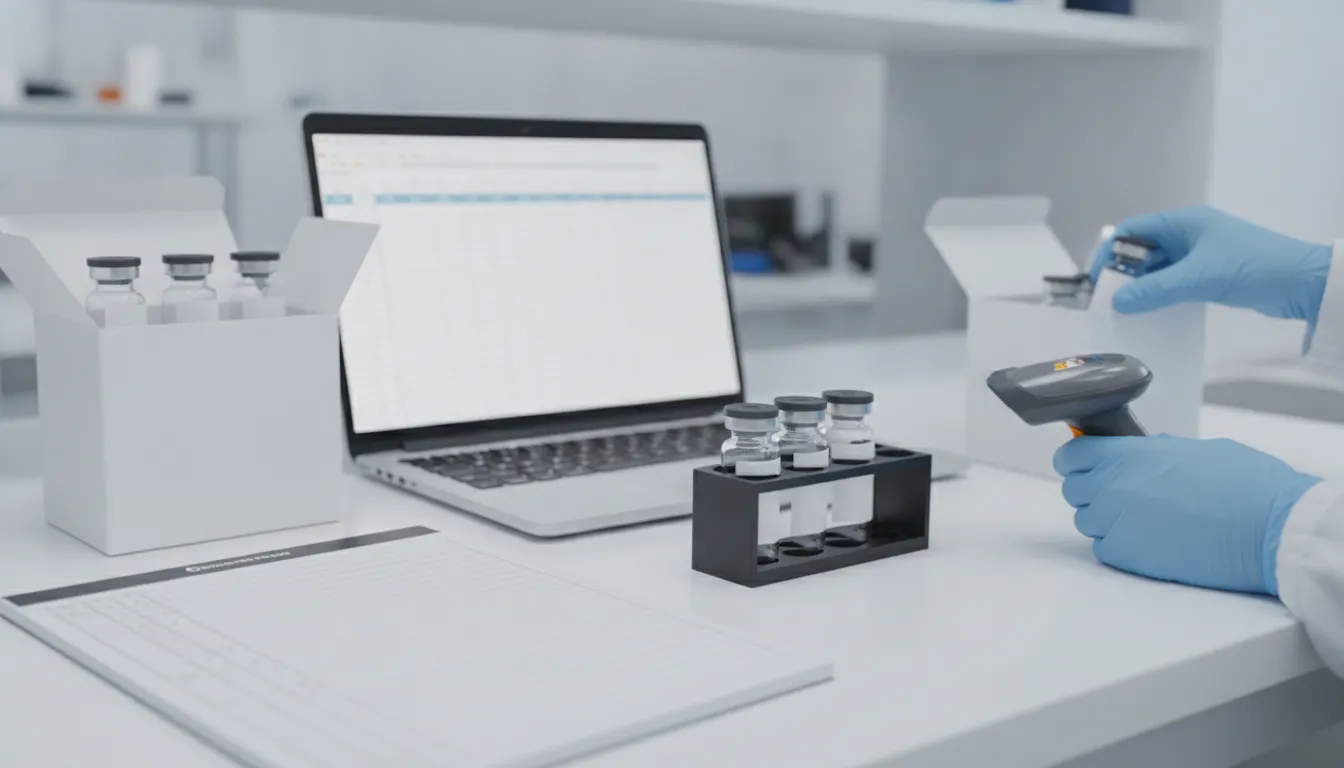
A research sample can sit on the bench and still be hard to account for. The label, storage place, custody history, or current status may be unclear. Laboratory sample tracking keeps those details tied to one container or one defined aliquot. The record runs from receipt or preparation through use, transfer, and disposition.
Laboratory sample tracking records what a research sample is, where it is, who has custody, and what its status is. A controlled spreadsheet, a bound log, or a laboratory information management system (LIMS) can hold that record. Each container still needs its own ID and a history the team can update.
For research materials, keep that ID separate from the product name, catalog slug, and vial capacity. If a container is divided, give each aliquot its own identifier and link it to the parent. That same habit makes routine moves easier to review.
What should laboratory sample tracking capture?
Laboratory sample tracking is the lab’s record of a physical research sample. It should say what the sample is, where it is, who has custody, and what its status is. Follow the sample from receipt or preparation through storage, use, transfer, and disposition.
That continuity matters when several containers hold related materials. It also matters when a sample moves between people, rooms, instruments, or in-vitro runs. Start with the container, not the catalog listing.
A sample ID should identify one container or one defined aliquot. It is not the material’s product name, a catalog slug, or a measurement of vial capacity. If one received container is divided, assign distinct identifiers and keep the parent link in the lab’s own records.
| Record field | What to write | A common mix-up |
|---|---|---|
| Unique sample ID | One identifier for the container or defined aliquot. | Using the product name, catalog slug, or vial capacity. |
| Material name | Exact name of the single compound or blend. | Treating a blend as one unnamed material. |
| Format | Physical format recorded by the lab, such as powder or solution. | Assuming format from the product name alone. |
| Labeled strength | Strength and units shown on the label or supporting record. | Confusing strength with container capacity. |
| Lot or batch if supplied | The lot or batch identifier provided with the material. | Inventing a lot number when none was supplied. |
| Location | Current storage location, using the lab’s naming convention. | Recording only the building or room. |
| Custodian | Person or team currently responsible for the container. | Leaving the original recipient listed after a transfer. |
| Status | A defined state such as received, in storage, checked out, returned, transferred, or disposed. | Using an unclear note such as “in progress.” |
A tracker can be a bound log, a controlled spreadsheet, or a LIMS. Choose the system that supports consistent updates and an auditable history. Core Pepti does not supply sample-tracking software, custody services, or laboratory testing.
The tracker stays the lab’s responsibility. Include the date received or prepared, plus any note that connects the record to the source material.
How laboratory sample tracking stays tied to the material
Before a container is opened, copy the catalog identity into the sample record. Start with the exact material name, selected strength, format, and supplier reference. Then assign a unique sample ID to that container or defined aliquot.
Core Pepti supplies research-use-only peptides and related compounds for U.S. laboratory, analytical, and in-vitro work. A team can start in the Core Pepti shop and record the product identity it selected. The sample ID does not replace that identity, and it is not a vial-capacity measurement.
Record strength as a property of the selected material, not as a guess about the container. Keep the exact material name, format, labeled strength, units, and any supplied lot or batch identifier in separate fields. If the catalog offers several variants, record the selected variant and the date the team reviewed the listing.
For a single compound, preserve the supplier’s name as supplied and keep it distinct from the sample ID. For a blend, record the blend as the named material and list only component amounts or identities that the supporting record actually states. Do not infer a component list, formula, strength, or price from a related product or from the container itself.
A product page can support procurement and initial identity entry, but it does not replace the laboratory’s container, custody, storage, preparation, or disposition record. Keep those events in the lab’s own tracker.
Keep the supplier’s stated identity next to the sample entry, and do not overstate it. Core Pepti states that its materials are third-party tested for identity, purity, and concentration. Put that attribution in the source or notes field.
The lab still owns the sample ID, storage location, custody events, status, and disposition. For how vial dimensions differ from material mass, use the Peptide Vial Sizes Chart: Capacity vs. Peptide Mass. These records support research use only.
How does laboratory sample tracking record custody?
A useful record answers four questions about a research container. What is it, where is it, who has had custody, and what status does it have? Follow the container from receipt or creation through use, transfer, and final disposition.
A bound log, controlled spreadsheet, or LIMS can hold the record. The lab chooses the system. Core Pepti does not provide tracking software or custody services.
Chain of custody covers the life of the sample. The Global Bioanalysis Consortium sample-management recommendations describe that history in paper and electronic records, including a LIMS where the lab has one. The paper also points to a unique identifier, storage location and conditions before and after analysis, and disposal documentation.
That paper includes clinical study samples. Do not copy patient-label rules onto research materials. This article is about documenting a research container, not identifying a clinical subject.
For one container, keep these fields together:
- Exact material name, and whether it is a single compound or a blend.
- Format, labeled strength and units, and any lot or batch identifier the seller provided.
- Date received or prepared, current location, custodian, and status.
- A note or link to the product record the team reviewed.
Define status terms the team can use the same way each time. Useful states include received, in storage, checked out, returned, transferred, consumed in an in-vitro run, or disposed. Those are record states, not a claim that one set of terms is required.
Use these five actions to keep the history legible:
- Assign a unique ID to each container. Do not use a product name, catalog slug, or vial-capacity measurement as the sample ID.
- Write the open storage location, and the relevant storage conditions, before the container is used or moved.
- Log each move with the previous location, new location, person responsible, and date. Record a status change with the old status, new status, person, and date.
- Give every aliquot its own ID and point it back to the parent container. Keep the parent ID on the parent, and never reuse one ID for two containers.
- Close the record when the material is disposed of or consumed, and write the final disposition.
Transport belongs in the same history only at a basic custody level. Record that the research container left storage, name the carrier, and check the container back in at its destination. Do not copy clinical specimen-shipping rules into this record.
Handwritten labels or an unlocked spreadsheet may work for a small set. They do not preserve a clear history of who changed a cell. If the lab needs an audit trail, use a controlled log or a LIMS. For the later analytical step, see the peptide analytical testing workflow.
When is a log enough, and when does a LIMS help?
A lab tracker connects a physical research sample with its identity, location, custody, and status. For a small set of samples, a bound log may be enough. A controlled spreadsheet can also work when the laboratory defines who may edit it and how changes are reviewed.
A LIMS is a more structured option for those records and related workflows. If you searched for “what is LMS in a laboratory,” the relevant term is usually LIMS, not a learning platform. In laboratory sample tracking, the extra “I” refers to information.
Match the system to the lab’s recordkeeping needs. There is no universal sample count at which software becomes mandatory.
| System | What it records well | What the lab still has to control |
|---|---|---|
| Bound log | Sample IDs, dates, locations, and status. | Legible entries and authorized access. |
| Controlled spreadsheet | Structured fields for identity, location, and status. | Permissions, backups, and overwrite protection. |
| LIMS | Centralized identity, status, and custody events. | User roles and a correction procedure. |
Handwritten labels and unlocked spreadsheets can serve a small set. Neither gives a reliable history of who changed a spreadsheet cell. If the lab needs an audit trail, use a controlled log or a LIMS and define the review process around it.
A laboratory sample tracking number is the lab’s own unique ID for a container or defined aliquot. It is not an order number from a seller, and a free app does not supply it automatically. Core Pepti does not sell tracking software or run the lab’s custody system. The laboratory selects, configures, and maintains its own tracker.
What limits apply when the material is for research use only?
Research-use-only status belongs in the sample record, not as a phrase added later. In laboratory sample tracking, the record and any label note should make the boundary clear. Core Pepti products are for in-vitro laboratory research by qualified professionals, and purchasers must be 18 or older.
They are not foods, drugs, supplements, or cosmetics, and they are not FDA-evaluated or FDA-approved. Review the Core Pepti terms and conditions for the full commercial and use limits.
Keep these limits visible on the record:
- The material is not for human or animal consumption.
- It is not for therapeutic, diagnostic, or clinical use.
- A product name, strength, or other catalog detail does not change that intended use.
- Do not replace the research-only boundary with language that suggests a treatment, test, or consumer product.
The distinction should stay visible when a sample is received, transferred, or cited in a research record.
Commercial terms belong in the purchasing record, not in the sample-status field. Sales are generally final. Replacement or refund is limited to a verified seller error or a manufacturing defect claimed within 48 hours of delivery, with photographic evidence. That window is a seller-review claim, not a laboratory-use instruction.
Core Pepti advertises free U.S. shipping once an order meets its published threshold. That offer is not a statement about other shipping charges or delivery timing. Keep shipping details out of the identity, custody, and status fields.
For how a lab can read analytical statements, see the peptide purity testing lab guide. That page covers the review question without changing the research-only boundary on the sample record.
Frequently Asked Questions
What should a laboratory sample tracking record include?
Start with a unique sample ID, exact material name, format, and labeled strength and units. Add the lot or batch identifier when one was provided, and the date received or prepared. Then add the storage location, current custodian, status, and a note or link to the product record the team reviewed. Keep the record tied to one container or one defined aliquot.
What is a laboratory sample tracking number?
It is a unique identifier for one container or one defined aliquot. It is not the product name, catalog slug, or vial capacity. When a container is split, keep the parent ID on the original. Assign each aliquot its own ID and link it back to the parent. Do not reuse an ID for two containers.
How does a lab document custody when a sample moves?
Record the previous location, new location, person responsible, and date for each move. When the status changes, record the old status, new status, person, and date. That history works in a controlled spreadsheet, a paper log, or a laboratory information management system.
Does a small laboratory need sample tracking software?
Not necessarily. A bound log or controlled spreadsheet can support a small set of research materials. An unlocked sheet may not preserve who changed a cell. If the team needs an audit trail, use a controlled log or a laboratory information management system. Core Pepti supplies research-use-only materials, not tracking software or custody services.
Review the material before you assign the sample ID
A tracking record is only as clear as the material name, format, and labeled strength written into it. Once those fields are defined, compare them with the live listing in the Core Pepti shop. Keep the research-use-only boundary on the record.