
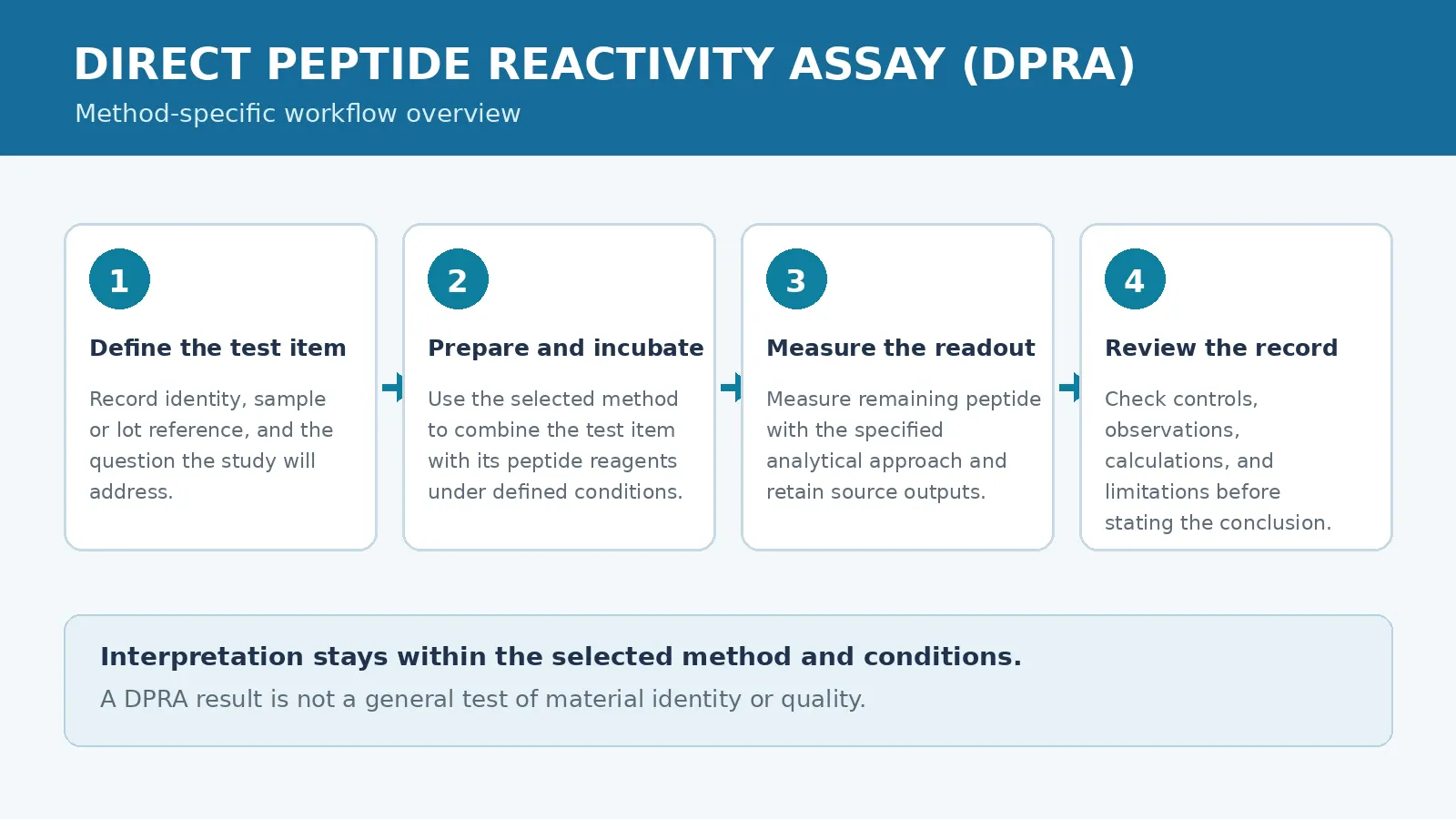
The direct peptide reactivity assay (DPRA) is an in-vitro method used to evaluate a specific type of chemical reactivity relevant to skin sensitization. It is not a general test of peptide identity, purity, or suitability for every experiment. For laboratory teams comparing assay evidence with research-material documentation, the key question is what the method can support, and what still needs separate evidence.
Discuss research material requirements
What does the direct peptide reactivity assay measure?
DPRA examines whether a test chemical reacts with synthetic peptides that contain nucleophilic amino acid residues, commonly cysteine and lysine. In broad terms, the peptide is exposed to a test item under defined conditions, and the amount of peptide remaining is measured. A decrease relative to appropriate controls can be interpreted as peptide depletion associated with reaction under those assay conditions.
The method addresses a narrow question: does the test item show reactivity with the specified peptide reagents in this system? The result depends on the test item, peptide reagents, solvent and other conditions, analytical readout, controls, and the protocol’s interpretation rules. The same number cannot be detached from those details and treated as a universal property of a material.
DPRA is one method used in the broader evaluation of skin-sensitization potential. A research paper describing the method’s pre-validation discusses its role as an alternative approach in that context (DPRA method study). A paper or overview can help orient a reader, but it does not replace the applicable protocol, validation documentation, or laboratory procedures used for a specific study.
When the next question is whether a particular research material fits a laboratory’s documentation needs, use the Core Pepti shop to review listed materials, then assess the specific item’s identity and available records separately from any DPRA result. Keep the distinction between an assay readout and a broader biological conclusion explicit. A peptide-depletion measurement reports what happened in a defined chemical test system. It does not by itself establish every biological step associated with sensitization, nor does it make a conclusion about all possible test conditions or uses.
How does a typical DPRA workflow proceed?
Exact procedures and acceptance criteria belong to the method protocol selected by qualified laboratory staff. At a planning level, a typical workflow can be understood as a sequence of decisions and checks rather than as a recipe:
- Define the question and test item. Record the chemical or material to be evaluated, the reason for testing, and the decision the data are intended to inform. Use a traceable sample or lot identifier where applicable.
- Review compatibility and available information. Gather identity, formulation, handling, and storage information that is relevant to the protocol. Consider whether the test item can be prepared in the required system and whether its properties could complicate the readout.
- Prepare the assay materials according to the selected method. The protocol governs peptide preparation, test-item concentration, solvent, controls, reaction conditions, replicates, and timing. Do not substitute an informal procedure or extrapolate values from a brief summary.
- Run the reaction and analytical measurement. Maintain the method-defined conditions, then measure remaining peptide using the specified analytical approach. Retain the source outputs rather than relying only on a final calculated value.
- Check run validity before interpretation. Review the required control behavior, replicate performance, analytical suitability, and method-specific acceptance criteria. If those checks are not met, treat the result as unresolved rather than forcing an interpretation.
- Review interference and observations. Note precipitation, unusual color, unstable preparations, possible signal interference, or other observations that could affect the measurement. Determine whether the protocol provides a way to handle them.
- State the conclusion at the proper level. Report the outcome in relation to the method and conditions actually used, with any deviations and limitations. Identify whether additional or complementary evidence is needed for the larger research question.
This sequence helps teams plan a review, but it is not a substitute for a validated method, laboratory quality system, safety procedures, or qualified technical judgment. The protocol and analytical setup should be chosen for the specific test item and study.
Which assay components need careful review?
A useful review links each result to the material and conditions that produced it. The table below is a planning aid. It does not add acceptance limits or procedural requirements; those must come from the applicable method documentation.
| Component | What to confirm | Why the review matters |
|---|---|---|
| Test item | Identity information available, sample or lot identifier, formulation, preparation, and handling record | A result is difficult to attribute if the tested material or its history is unclear. |
| Peptide reagents | Reagent identity, preparation record, storage, and protocol-defined suitability | Changes in reagent condition may affect the amount measured after the reaction. |
| Controls | Required control types and their observed results, assessed against method criteria | Controls help show whether the run behaved as expected and whether the data can be interpreted. |
| Reaction conditions | Protocol-defined concentrations, solvent, timing, and environmental conditions | Unrecorded or unauthorized changes can weaken comparability and obscure the reason for a result. |
| Analytical readout | Instrument method, suitability checks, raw output, and possible interference | A changed signal may reflect analytical effects as well as peptide depletion. |
| Calculations and record | Replicates, calculation steps, exclusions, deviations, and reviewer notes | A transparent trail lets another qualified reviewer reconstruct how the conclusion was reached. |
How should a researcher interpret peptide depletion?
Start with validity, not with the most attention-grabbing number. Ask whether controls met the method’s criteria, whether replicate results were acceptable under the protocol, and whether the analytical signal was suitable for calculation. A reported depletion value from a run that did not satisfy essential checks may not support a meaningful interpretation.
Next, ask whether the test item could have affected the measurement. Solubility issues, precipitation, instability, color, or interaction with the analytical system can complicate the relationship between signal and reaction. For example, if material precipitates during preparation, the apparent amount of peptide remaining may not reflect only the intended chemical reaction. The observation should be documented and reviewed under the method’s procedures, not silently treated as routine variation.
Then keep the conclusion tied to the data. A careful statement identifies the test item, assay approach, conditions, validity status, and observed outcome. It also says what the result does not answer. Avoid translating a method-specific result into a broad statement about safety, complete biological activity, or suitability for an unrelated research application.
Comparisons require the same restraint. Two reported results may not be directly comparable if protocols, test-item preparations, analytical methods, acceptance criteria, or reporting conventions differ. Before comparing, establish which parts of the method match and which do not. If key information is missing, describe the comparison as limited rather than implying a controlled head-to-head evaluation.
How should teams compare DPRA reports?
Before placing two reports side by side, identify whether they describe the same kind of test item and the same analytical question. Similar terminology does not guarantee that the studies used matching materials or conditions. Check the exact test-item name, sample identifiers, formulation information, preparation notes, and any available reference to the material’s source. If one report concerns a mixture and another a defined compound, the apparent similarity of their labels does not make the results equivalent.
Next, compare method details. Look for the method or protocol version, peptide reagents, analytical readout, control results, replicates, acceptance review, and reported deviations. These details establish whether each result is interpretable and whether the two methods have enough in common for a useful comparison. If one report omits critical details, record the gap rather than filling it with assumptions. A summarized table of outcomes is not a substitute for the underlying method and run record.
Then separate three kinds of comparison. A within-study comparison asks how test items were evaluated under the same documented setup. A between-study comparison asks whether reports from different runs or laboratories can be considered together, which requires careful review of method alignment and data quality. A material-document comparison asks whether a product record identifies the same test item used in the assay. The last comparison is especially important when a paper reports a result for a named substance but the laboratory is considering a specific supplied sample: matching names alone may not establish a link to that sample or lot.
A practical comparison worksheet can use one row per report and columns for test-item identifier, method version, peptide reagents, analytical approach, controls and validity, observations or interferences, replicate-level data, deviations, and stated conclusion. Mark each field as documented, not reported, or requiring clarification. That simple status language is more informative than leaving a blank cell that could be mistaken for a negative finding. Where a material difference prevents direct comparison, state it plainly and limit the conclusion to the evidence available.
Finally, preserve the distinction between a result that is different and a result that is not comparable. A difference may be meaningful when studies are sufficiently aligned and valid; a lack of alignment means the reason for different values cannot be assigned from the summaries alone. This approach keeps discussion focused on observable evidence and gives the next reviewer a clear path to resolve missing information.
What does DPRA not establish?
- It is not a general identity test. Reactivity with assay peptides does not independently confirm the test item’s molecular identity. Identity requires evidence designed for that analytical question.
- It is not a purity certificate. A peptide-depletion result does not quantify every impurity or demonstrate a particular purity level. A separate analytical assessment must be interpreted according to its own method and documentation.
- It is not a universal performance screen. It does not show how a material will behave in every assay, model, or method-development workflow. Compatibility is specific to the intended experimental system.
- It is not a complete biological assessment. One in-vitro method contributes information within its defined scope. It is not, alone, a complete determination of sensitization or another biological outcome.
- It is not a substitute for material records. A supplier description and an assay result answer different questions. Sample identifiers and relevant documentation must still be reviewed for the material being considered.
These distinctions matter because research teams often review several kinds of evidence together. A structural identity result, a purity assessment, a concentration measurement, a stability record, and a DPRA result should not be treated as interchangeable simply because they refer to the same sample. Each item supports a different part of a decision.
What does a useful review look like in practice?
Consider a team that receives a depletion result for a coded test item. The first reviewer checks the report and sees a calculated value but no clear link to the preparation record. The useful next step is not to infer what the code represents. The team checks the sample log, confirms the code-to-material link, and verifies that the report names the method version and relevant test conditions. If that link cannot be confirmed, the conclusion should remain qualified.
In a second example, controls appear acceptable, but the record notes visible precipitation in one preparation. The team should determine whether the selected protocol covers that observation and whether the analytical output is interpretable under its criteria. It should preserve the observation, raw output, and any method-directed follow-up. It should not automatically label the change as chemical reactivity or discard the observation because the final calculation is available.
A third case involves comparing results from two reports produced at different times. One report includes the method version, reagent information, replicate data, and interference notes; the other gives only a summarized result. The first report may be easier to evaluate, but that does not mean the two results are directly comparable. A reviewer can list the missing fields, seek clarification through the study’s approved channels, and restrict any comparison to what the records support.
These examples show why interpretation is a chain of evidence. The sample identity, preparation, run conditions, control behavior, analytical output, calculations, and final wording must remain connected. A break in one link does not always invalidate all work, but it does affect what can responsibly be concluded.
What information belongs in the assay record?
A reviewable record should let another qualified person understand what was tested, how the work followed the selected method, and how the result was derived. The exact record format depends on the laboratory, protocol, and applicable quality procedures, but the following categories are useful to consider:
- Study purpose, protocol title or identifier, version, and date of use.
- Test-item description and sample or lot identifier, with the source record linking them.
- Peptide reagent information, preparation details, and relevant storage or handling notes.
- Test-item preparation and any recorded observations that could affect assay behavior.
- Protocol-defined conditions and the identity of any approved deviations.
- Control results, replicate-level data, instrument outputs, and suitability checks.
- Calculation steps, data exclusions and their rationale, acceptance review, and final interpretation.
- Reviewer identity or sign-off as required by the laboratory’s quality system, along with unresolved questions and planned next steps.
Keep raw data and summaries linked. A summary table is convenient, but it should not replace underlying outputs or the calculation path. If a repeat or complementary analysis is performed, preserve the relationship between the original and follow-up records, including why the follow-up was selected. This makes later review more reliable and reduces the risk that an isolated value will be separated from its context.
Teams developing broader records procedures may find it useful to compare this assay record with general laboratory sample-tracking practices. The goal is not to force every assay into one form. It is to maintain unambiguous links among sample identifiers, preparations, measurements, and interpretations.
How does DPRA relate to research-material selection?
DPRA is usually not the criterion for selecting a peptide reagent intended for an unrelated experiment. Material selection begins with the requirements of the planned research: the chemical identity and format needed, the amount or concentration information relevant to the method, handling and storage requirements, and the analytical documentation appropriate to the work. A DPRA result cannot fill gaps in those separate categories.
For example, a laboratory developing an analytical method may need a reference material with an identity record that can be matched to the study sample. A DPRA result does not by itself show that the reference material has the expected identity or concentration. Likewise, a material description does not establish how it will behave in a DPRA system. Ask what evidence answers the specific question, and evaluate each document on its own terms.
When reviewing the terminology used for a research material, a general peptide chemistry overview can help distinguish sequence, structure, and method questions. For supplier-specific product and catalog context, consult the research reagents information and review the actual material listing and available records. These pages are starting points for product context, not independent proof of a particular lot’s characteristics.
Core Pepti presents itself as a supplier of research-use-only peptides and related compounds for laboratory, analytical, in-vitro, and method-development work. Its About page provides the seller’s stated positioning. Attribute quality and testing claims to the seller unless lot-matched supporting records are available and independently reviewed. Do not infer an unreported test or certification from a general supplier description.
For prospective research buyers, the Core Pepti shop is the product-discovery destination. Review the identity, format, and available documentation for the specific listing against the laboratory’s requirements; do not assume that a DPRA result applies to a listed product unless the test item and its records establish that connection.
What reporting mistakes make a result harder to use?
Several avoidable gaps can weaken a DPRA report even when the laboratory has collected useful data. One is presenting only a final value without a clear path back to the source outputs and calculation. A reviewer should be able to see how the value was produced, which replicates contributed, and whether any observations were excluded. If the report uses an exclusion or adjustment, it should identify the rationale and the applicable method guidance rather than leaving the reader to guess.
A second gap is reporting the test-item name without a sample identifier or preparation context. A name may identify a chemical class or catalog entry, but it may not distinguish the specific sample, formulation, or lot that entered the experiment. Include enough information to link the report to the source record without overstating what that identifier confirms. If identity evidence is separate, make that separation explicit.
A third problem is omitting run-validity information. Reporting a calculated depletion value without control performance and acceptance review leaves the reader unable to assess whether the run met the method’s conditions for interpretation. Similarly, omitting a deviation or visible interference can make a result look more straightforward than the documented experiment actually was. A concise note about a limitation is more useful than silence.
Finally, avoid conclusions broader than the measured endpoint. A report that says the assay observed reactivity under stated conditions is easier to evaluate than one that converts that observation into a universal claim. Pair each conclusion with its boundary: test item, method, conditions, validity status, and any unresolved issue. This practice supports careful review and helps prevent a narrow measurement from being reused as evidence for a different question.
What should procurement teams ask before ordering?
Procurement and technical reviewers can reduce avoidable uncertainty by agreeing on the evidence needed before an order is placed. A concise checklist can include:
- Is the chemical identity and product format stated clearly enough for the intended laboratory work?
- Which sample or lot identifiers will appear on the material and its accompanying records?
- What analytical documentation is available for this specific item, and is it matched to the relevant lot?
- Are storage, handling, and preparation details adequate for the laboratory’s method?
- Can the supplier clarify what a document does and does not demonstrate, without treating one assay as a substitute for another?
- Does the planned use remain within qualified research, analytical, in-vitro, or method-development work and applicable purchasing requirements?
These are practical questions for material evaluation, not a claim that every supplier provides every record. Core Pepti’s separate wholesale inquiry page is relevant to laboratories considering a high-volume or customized purchasing discussion. Confirm the requirements and available documentation for the specific inquiry rather than assuming a particular volume threshold, price, lead time, or testing record.
Core Pepti products are for research use only by qualified professionals and are not for human or animal consumption, clinical, therapeutic, or diagnostic applications. The materials are not marketed as foods, drugs, supplements, or cosmetics. This boundary should remain clear in procurement records and in any intended laboratory workflow.
Review research materials in the shop
Frequently asked questions
Is DPRA the same as a peptide identity or purity test?
No. DPRA evaluates reactivity with specified synthetic peptides under defined assay conditions. Identity and purity are separate analytical questions and require evidence suited to those questions.
Does peptide depletion alone prove a complete sensitization outcome?
No. It is a method-specific readout that can contribute to a broader evaluation. It does not, by itself, establish a complete biological conclusion.
Can a DPRA result be applied to any peptide or material?
Do not assume universal applicability. The test item, solubility and compatibility, analytical interference, protocol requirements, and interpretation criteria need review for the particular study.
What should a team do with an unexpected result?
Preserve raw data and document preparation, controls, observations, instrument conditions, deviations, and interference checks. Review run validity first and follow the laboratory’s approved procedures for any repeat or complementary analysis.
Review research materials in the shop
The direct peptide reactivity assay is most useful when its defined scope stays visible: it measures a particular form of reactivity under specified conditions, while identity, quality, and suitability require evidence matched to each separate question.