
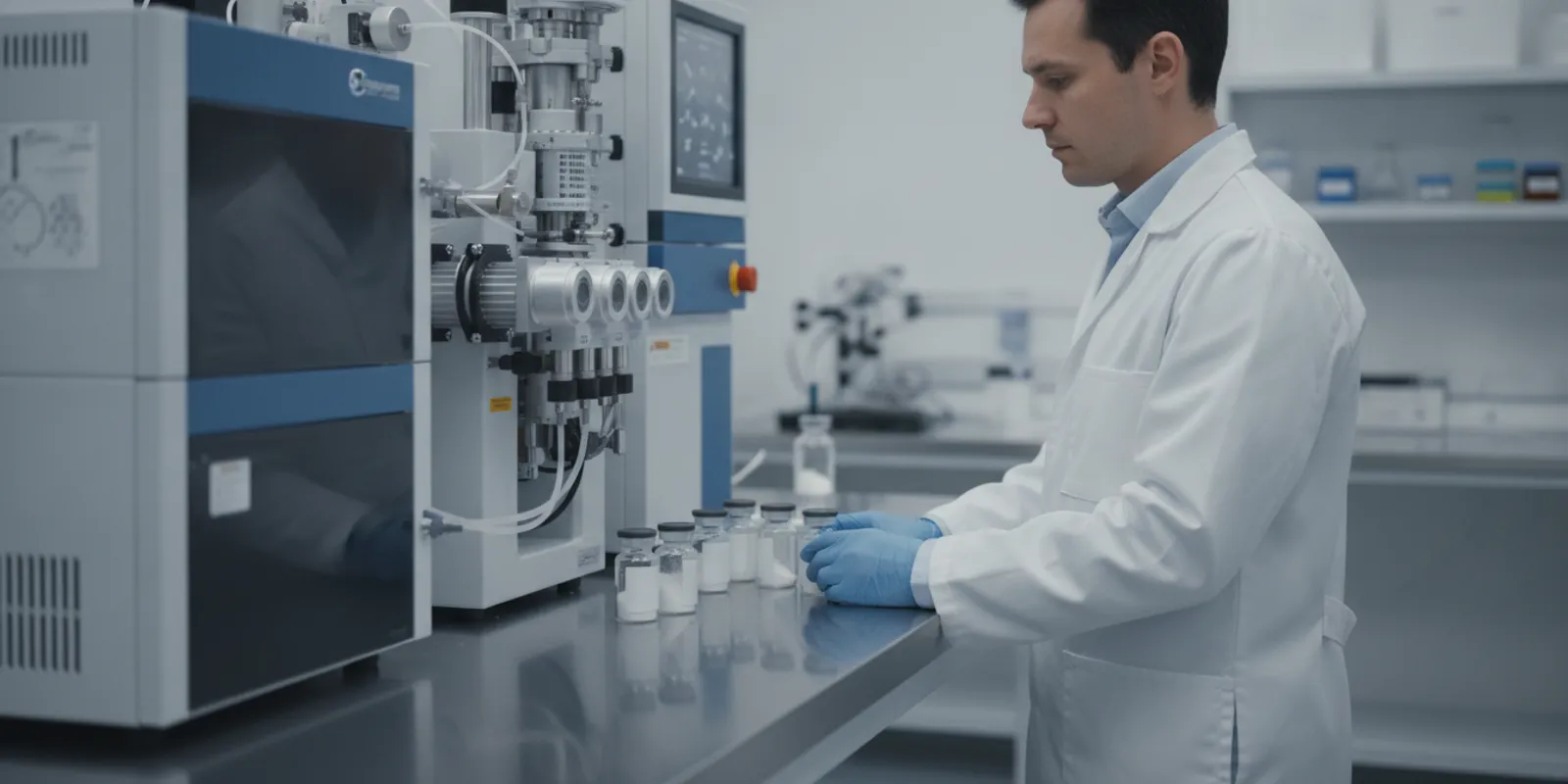
Peptide purification is a set of separation steps used in research workflows to reduce unwanted components in a peptide-containing sample and support later characterization or assay preparation. The right approach depends on the research question, the sample’s properties, and the evidence needed to interpret the result. Purification alone does not establish identity, purity, stability, or suitability for a particular experiment.
Contact the research materials team
What question does peptide purification answer?
A synthesis or isolation process can yield a mixture rather than a single desired component. The mixture may contain the target peptide alongside related sequences, truncated products, residual reagents, salts, solvents, or other process-related material. Which components are present depends on how the material was made and handled. These are general possibilities, not a statement about any particular product or lot.
Purification aims to separate components based on differences in properties such as charge, hydrophobicity, size, or affinity for a stationary phase. Researchers may use it to enrich a component of interest, remove some impurities, or prepare fractions for further analysis. The word “purified” needs context: the term does not, by itself, specify the method, acceptance criteria, measured composition, or the analytical evidence behind a claim.
Before choosing a method, define the outcome the workflow needs. Is the goal to separate a target from closely related sequences? To desalt a fraction? To produce enough material for an in-vitro assay? To compare fractions? Each goal leads to different method choices and evidence requirements. This decision framing is distinct from a full peptide purification methods guide; here the emphasis is how separation, tracking, and analytical documentation fit together.
How do common purification method categories differ?
Chromatographic separation is a central family of purification approaches. A sample moves through a system containing a stationary phase while a mobile phase carries components at different rates. The separation reflects interactions between the sample components and the system. Method development may require adjustment and assessment; no single method is appropriate for every peptide or sample.
| Method category | Separation basis | Common research role | Important limitation |
|---|---|---|---|
| Reversed-phase chromatography | Differences in hydrophobic interaction with the stationary phase | Separating many peptide mixtures and collecting fractions for characterization | Conditions can affect recovery and the separation of closely related components; a chromatographic trace alone is not a complete identity assessment. |
| Ion-exchange chromatography | Differences in net charge under defined conditions | Resolving components with meaningfully different charge behavior | Performance depends on pH, ionic conditions, and sample properties; similar charge behavior can limit resolution. |
| Size-exclusion chromatography | Differences in effective molecular size in solution | Separating some size-distinct components or examining size-related species | It may not resolve components of similar size and is not a universal method for peptide impurity separation. |
| Affinity-based separation | Selective interaction with an immobilized binding partner or ligand | Enriching a target when a suitable, selective interaction is available | Requires a relevant and selective interaction; binding and elution conditions can influence recovery. |
| Precipitation or membrane-based steps | Differences in solubility or membrane passage | Preliminary cleanup, concentration, or fractionation in a broader workflow | Often offers limited selectivity for closely related peptide species and may need follow-up separation. |
The table describes broad concepts, not operating instructions or guaranteed outcomes. Teams should select and validate conditions for their own material, equipment, and research purpose. A separation that produces a visually distinct peak or fraction is not automatically proof that the fraction contains only the intended peptide.
How should researchers choose a separation approach?
Start with the properties relevant to the target and the likely impurities. Sequence, length, charge behavior, hydrophobicity, solubility, and sample matrix can all affect separation. The assay and downstream analytical methods matter too. A workflow designed to distinguish close sequence variants may need a different selectivity than one intended mainly to remove salts or separate a much larger species.
- Define the research objective. State whether the workflow seeks enrichment, fractionation, cleanup, or comparison. Avoid treating these as interchangeable outcomes.
- Identify what must be distinguished. Consider plausible related sequences, degradation products, residual process materials, and matrix components, while avoiding unsupported assumptions about their presence.
- Match the method to the property. Choose a separation principle relevant to the differences between target and components of interest.
- Plan how fractions will be assessed. Decide in advance what evidence will be used to compare fractions and what constitutes a useful result for the defined research question.
- Record deviations and limitations. Note when a run, recovery, or analytical result does not match expectations. Do not omit inconvenient data from the workflow record.
Method selection is only one part of a defensible workflow. Sample identity must remain clear from receipt through collection and analysis. For broader planning around research materials and study goals, see this guide to research peptide study design.
What sample information should be tracked?
Purification creates a sequence of related materials: starting sample, prepared sample, run, collected fractions, pooled material, and any aliquots reserved for analysis. If identifiers are lost or reused, it becomes difficult to connect a result to the material that produced it. A consistent naming scheme and contemporaneous records help prevent that break in traceability.
At receipt, assign a unique sample identifier and record the source description exactly as provided, including the stated name, lot or batch reference if available, format, and date received. Do not silently “correct” a label or infer details absent from documentation. If the stated identity, strength, or form appears inconsistent, preserve the original wording and flag the discrepancy for resolution before use.
For each preparation or purification event, connect the starting identifier to the run record. Record the date, operator or responsible role, method category, relevant equipment identifier, run reference, and any protocol version used. Capture the identifiers assigned to collected fractions and explain pooling decisions. If material is split, each child aliquot should retain a clear link to its parent sample and fraction.
- Use unique, stable identifiers for samples, fractions, and aliquots.
- Keep label text legible and consistent with the record; avoid ambiguous abbreviations.
- Record dates, run references, method and protocol versions, and relevant deviations.
- Document transfers, storage locations, and disposition according to the laboratory’s established procedures.
- Link raw instrument files and analysis outputs to the corresponding sample and run identifiers.
- Preserve the distinction between a supplier’s description and observations generated by the laboratory.
Records should make it possible for another qualified team member to reconstruct which material was processed, which fractions were retained, and which evidence supports a conclusion. The record does not need to claim more than the workflow establishes. A documentation checklist can also be paired with a broader supplier evaluation checklist, while keeping supplier statements separate from laboratory-generated results.
Which analytical checks help document the workflow?
Purification and analysis answer related but different questions. Separation describes a process. Analytical checks provide evidence about the resulting material, within the capabilities and limitations of the method used. A sound record states what was measured, how the result was interpreted, and what it cannot establish.
Chromatographic assessment
Chromatography can be used to examine the number and relative appearance of detectable components under specified conditions. A chromatogram should be interpreted with the method details, detector, integration approach, and sample context in view. A single peak does not necessarily prove a single chemical identity: components may co-elute, fall below detection, or be poorly observed under the selected conditions. If a percentage is reported, the basis and calculation should be clear and should not be treated as a universal measure of all impurities.
Mass-based identity evidence
Mass spectrometry can provide mass-related evidence that helps assess whether an observed species is consistent with an expected molecular mass. This evidence is not identical to full sequence confirmation, nor does it automatically quantify all components or establish a sample’s overall composition. The method, observed signals, and interpretation should be documented rather than reduced to an unqualified “confirmed” statement.
Sequence or structural confirmation
Where the research question requires it, additional analytical approaches may provide evidence about sequence or structure. The method selected should be appropriate to the material and question. Teams should distinguish direct evidence from inference and record limitations, such as incomplete coverage or ambiguity, where relevant.
Other checks and controls
Depending on the workflow, researchers may examine concentration, residual solvent or salt, water content, or stability-related changes. These checks are not universally required, and their relevance depends on the intended in-vitro research use. A result in one category does not substitute for another: a mass-consistent signal does not establish purity, and a chromatographic profile does not necessarily establish identity.
For each check, retain the sample identifier, method or instrument reference, date, raw data location, processing or integration settings, reference materials or controls where applicable, and the result with its interpretation. Record whether a result applies to the starting material, a collected fraction, or a pooled sample. This distinction prevents a result for one fraction from being mistakenly attributed to another.
How can conclusions stay proportional to evidence?
Good reporting uses carefully bounded language. Describe the method and observation before drawing a conclusion. For example, “the recorded chromatographic method showed the reported peak pattern for fraction F-03” is more informative than claiming that a material is “pure” without defining the basis. If mass analysis produced a signal consistent with an expected value, state that specific observation and avoid implying that it resolves every identity or composition question.
Keep three evidence layers distinct:
- Source information: the supplier’s product description, stated identity, and any documentation supplied with the material.
- Process records: what the research team did, including sample preparation, separation, fraction collection, and handling.
- Analytical observations: results generated from identified samples using documented methods.
These layers can inform each other, but they are not interchangeable. A supplier statement is not a laboratory result from the receiving team. A purification step is not an analytical result. An analytical result is not automatically a general guarantee about every portion of a batch or about future work. Core Pepti describes materials as research-use-only compounds; a product listing or general description should not be treated as a substitute for lot-specific evidence.
When reviewing source documentation, note what is present and what is missing. If a lot-matched analytical record is not available for review, say so plainly rather than assuming that a claim has been independently verified. For context on compound documentation and selection, teams may also review the research compound material selection guide.
What errors commonly weaken a purification record?
- Using “purity” without a basis. State the test, conditions, and interpretation behind any purity-related description.
- Confusing a method with a result. Naming chromatography or mass spectrometry does not show what a particular sample’s data established.
- Breaking the sample chain. Unlinked fraction labels or pooled samples can make otherwise useful data ambiguous.
- Overinterpreting one measurement. A single analytical technique may not answer identity, composition, and quantity questions at once.
- Omitting conditions and processing. Without method versions, settings, or integration information, a result may be difficult to compare or reproduce.
- Mixing supplier claims with team findings. Attribute each statement to its source and retain the evidence boundary.
- Reporting only successful runs. Deviations and unsuccessful separations can be important context for interpreting the workflow.
These problems are often preventable with a short pre-run review: verify labels, confirm the intended separation question, check that fraction identifiers are ready, and ensure the analysis plan matches the decision the team needs to make.
How can a team review a run from start to finish?
A practical review sequence helps connect planning, separation, and evidence without turning a general article into an operating protocol. The purpose is not to prescribe instrument settings. It is to make sure each decision has a documented reason and each conclusion can be traced to the material and data that support it.
Before the run: state the decision to be made
Write a short statement of the question the separation is meant to help answer. For example, a team may need to determine whether a fractionation step changes the detectable profile of a sample, whether a cleanup step reduces a matrix component relevant to a later measurement, or whether two collected fractions merit separate characterization. Each statement identifies a decision without assuming that purification will succeed.
Next, specify what evidence would be relevant. If the objective is to compare profiles, identify the analytical method and comparison basis before samples are processed. If the objective is to distinguish a target from a related component, assess whether the planned separation and follow-up checks have enough discriminatory power for that question. If the method cannot resolve the distinction, a negative or ambiguous result should not be treated as proof that the components are identical or absent.
Review the starting material description, lot reference if provided, sample amount as recorded by the laboratory, container label, and any handling notes available. Record missing information as missing. Do not infer composition, stability, or suitability from the appearance of a container or from a general catalog description. When documentation is unclear, pause the interpretation and resolve the record issue through the appropriate research or supplier channel.
During the run: maintain links between material and events
Assign identifiers before collecting fractions, not after. A useful scheme is stable and readable, and it distinguishes the parent sample, run, fraction, and later aliquot. The exact format is a laboratory choice; the essential point is that two materials cannot accidentally share an identifier and that the link between parent and child remains visible in the record.
Capture events as they occur. Note the run reference, method version, date, equipment reference, collection sequence, deviations, and any decisions about which fractions to retain or combine. If a fraction is excluded, record the reason rather than deleting its existence from the record. If a run is interrupted or a collection label is uncertain, flag the ambiguity before analysis. Reconstructing these details from memory later is less reliable than recording them contemporaneously.
When fractions are pooled, preserve the identities of the contributing fractions and document the pooling decision. A pool is a new material with a traceable parent set, not a replacement for the original fraction records. The same rule applies when splitting material for separate analyses: each aliquot should connect to its source and indicate the purpose or destination if known.
After the run: connect observations to decisions
Review the analytical data against the stated question, not against a broad claim the method was not designed to answer. Confirm that the data file and processing record refer to the correct sample identifier. Compare like with like: the same method, relevant settings, and appropriate controls or reference materials where applicable. If the conditions differ, document the difference and avoid presenting the values as a direct comparison without qualification.
Separate observations from interpretations in the run summary. An observation might describe a detectable pattern under the stated method. An interpretation might say that the pattern is consistent with enrichment, subject to the method’s sensitivity and resolution. A conclusion should then state whether the evidence was adequate for the original decision. This sequence keeps a plausible interpretation from being presented as a direct measurement.
Finally, record unresolved questions and the next analytical step, if one is justified. A result may support further method development rather than a definitive answer. Marking uncertainty is useful: it tells a later reviewer what remains unknown and prevents an ambiguous result from being quietly converted into a confident claim.
How should a team compare fractions without overreading them?
Fraction comparison is a common point where labels, measurements, and assumptions can become tangled. A simple comparison plan begins by identifying the intended comparison units. Are the samples the starting material and a collected fraction, two separate fractions, or replicate analyses of one pool? That distinction determines what the result can say.
Use a consistent naming map in tables, plots, and notes. For example, write the sample identifier in the figure legend and preserve the same label in the raw-data file reference. Avoid labels such as “best,” “clean,” or “final” unless the team defines what those terms mean. Neutral names such as fraction identifiers reduce the risk that an expectation influences how data are described.
When interpreting differences, check the method’s limits first. A visibly changed profile can reflect a change in detectable components under those conditions, but it does not alone identify every peak. A missing signal could arise from a component being below detection, from altered response, or from differences in sample preparation. A similar profile does not prove identical composition if the method lacks resolution for the components in question.
Where a team uses a threshold or acceptance criterion, state where it came from and how it applies to the research question. Do not introduce a threshold after seeing the data simply because it makes a result look favorable. If the project is exploratory and no prespecified threshold exists, describe the comparison as exploratory and report the basis used to assess it. This preserves the distinction between a planned decision rule and a later interpretation.
Consider an illustrative case: a starting sample and two fractions are examined using one chromatographic method. Fraction A has a different detectable pattern from the starting sample, while fraction B appears similar. The defensible statement is limited to those observations under the method used. Additional identity-sensitive evidence may be needed before assigning a specific component to A or claiming that B contains no relevant impurity. The case shows why a separation result and an identity claim are not interchangeable.
What should be included in a concise run summary?
A useful summary does not repeat every instrument detail, but it provides enough context for a reviewer to locate the evidence and understand the decision. A structured record can include:
- Purpose: the research question and intended decision.
- Material lineage: starting sample identifier, source description, lot reference if available, and child fraction or pool identifiers.
- Process reference: separation method category, procedure or version, run identifier, equipment reference, and dates.
- Events and deviations: relevant changes, collection decisions, exclusions, and unresolved label or handling questions.
- Analytical plan: which checks were planned and which were completed, with sample identifiers for each.
- Results: observations, processing basis, controls or references used where relevant, and data-file locations.
- Interpretation: what the evidence supports, limitations, and what remains uncertain.
- Disposition: where material was transferred or retained, according to the laboratory’s procedures.
This format also makes review more efficient. A colleague can see quickly whether the run addressed its original question, whether the correct fraction was analyzed, and whether a claim depends on a measurement that is not present. If a report will be shared beyond the team, preserve the same evidence boundaries and avoid removing context that affects interpretation.
Frequently asked questions
Does purification prove that a peptide is pure?
No. Purification is a separation process. Claims about composition require appropriate analytical evidence, a stated method, and a clear basis for interpretation. No single process label establishes a universal purity level.
Is one purification method best for every peptide?
No. Method choice depends on the properties of the target and other components, the sample matrix, the research question, and the available analytical checks. Teams should assess the suitability of a method for their own workflow.
Why label fractions if they will be analyzed right away?
Fractions can be transferred, compared, pooled, or revisited later. Unique labels make it possible to connect each analytical result to the correct collected material and preserve an interpretable record.
Can a mass result establish overall sample purity?
Not by itself. Mass-related evidence may support assessment of a species’ expected mass, but it does not automatically quantify all components or rule out substances that the method does not detect or distinguish.
Ask a question about research materials
Well-documented purification connects a clearly defined research question to traceable samples and appropriately interpreted analytical evidence. Keeping those links explicit makes the workflow easier to review without claiming more than the data support.